
Your Tradie Business Doesn't Need an After-Hours Message. It Needs a Receptionist That Answers.
You're not losing calls because you're bad at business — you're losing them because you're busy on the tools. Here's how an AI receptionist for tradies keeps leads moving.
You're Not Losing Jobs Because You're Bad at Business
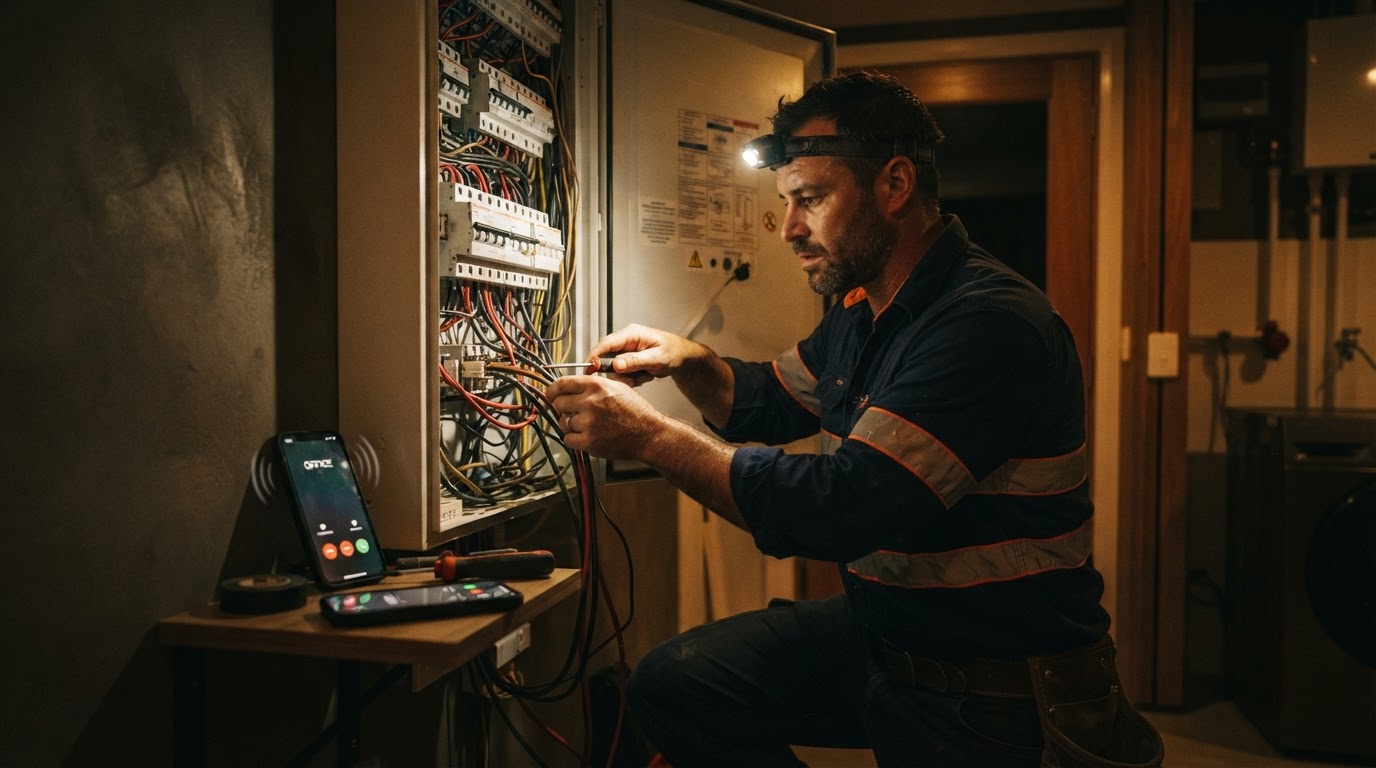
Let's get this out of the way first. If you're missing calls, it doesn't mean your business is broken. It usually means the opposite — you're busy. You've got jobs on, you're on-site, and the phone keeps ringing while you're trying to get the work in front of you done.
Most tradies didn't start their business to sit in an office answering the phone. You started it to do good work, build a reputation, and earn a living. The problem is that the phone doesn't care whether you're up a ladder or under a house. It just rings.
You're Losing Calls Because You're Busy Doing the Work
Think about a normal day. You're driving between jobs. You're working with tools. You're on a roof, in a ceiling, or elbow-deep in a repair. You're talking to a customer about the job you're on right now. In all of those situations, picking up the phone is either impractical, unsafe, or just plain rude to the customer in front of you.
So the call goes unanswered. And the customer on the other end? They don't know you're on a job. They don't know you'd love to help them. All they know is that nobody picked up — so they call the next business.
This is the gap an AI receptionist fills. It's not about replacing you. It's about making sure the phone doesn't become the point where the lead disappears.
What Happens When You Miss a Call?
When a customer calls and gets no answer, a few things tend to happen — none of them good for your business.
They might leave a voicemail, but most don't. They might call back later, but by then they've often already booked someone else. Or they simply move straight down the Google results and call the next tradie who picks up.
The longer the gap between their call and a real response, the less likely you are to win the job. A missed call isn't just a missed conversation — it's a missed opportunity, and often a missed job.
What Happens When an AI Receptionist Answers?
Now picture the same call, but this time an AI receptionist picks up. The customer isn't sent to voicemail. They're not told to call back later. They get a response — right then, in the moment they're ready to talk.
The AI greets them, asks what they need, collects their details, and helps them take the next step. By the time you check your messages, you've got a qualified enquiry with context, not a mystery voicemail you have to decode.
That's the difference. The customer feels acknowledged. The enquiry is captured. And you've got something to work with instead of a gap where a lead used to be.
You Decide When AI Answers
The biggest concern tradies have about an AI receptionist is that it'll answer every call and get in the way. It won't — because you're in control of when it steps in. TradePA lets you configure call handling around your business, not the other way around.
Here are the three ways tradies typically set it up:
How Do You Want Your AI Receptionist to Work?
You choose the setup that works for your business.
Answer Every Call 24/7
In 24/7 mode, the AI is your always-on receptionist. Every call gets answered, whether it's 2pm or 2am. This suits businesses that compete on responsiveness — emergency plumbers, locksmiths, after-hours electricians — or any trade that doesn't want to lose a lead to a faster picker-upper.
The customer always gets a consistent, professional response, and you always get the enquiry details to follow up on.
Answer Missed Calls After a Number of Rings
If you'd rather answer calls yourself when you can, missed-call mode is the sweet spot. Your phone rings. If you or your team pick up, great — nothing changes. If nobody answers after the number of rings you've chosen, the AI steps in so the customer isn't left hanging.
You decide how many rings happen before the AI takes over. It's a backup that only kicks in when you genuinely can't get to the phone, not a replacement for your own answering.
Handle After-Hours Calls
Maybe your daytime process is fine and the real problem is what happens after you knock off. In after-hours mode, your team handles calls during business hours and the AI takes over outside those hours.
Instead of customers hearing a recorded message telling them to call back tomorrow, they get a real response. The enquiry is captured, the customer knows what happens next, and you start the next day with leads waiting rather than a cold list of voicemails.
Your AI Receptionist Can Be Configured Around Your Trade
An AI receptionist isn't one-size-fits-all. It's configured around the specifics of your business — the services you offer, the areas you cover, your hours, and the information you want captured from each call.
A plumber's AI might ask whether it's an emergency or a routine booking, capture the suburb, and note the type of issue. An electrician's might ask whether it's a fault, an installation or a quote, and record the property type. A builder's could ask about the project type and whether plans are ready. The questions change to fit the trade, because the enquiries are different.
| Feature | After-Hours Message | AI Receptionist |
|---|---|---|
| Answers customer questions | No | Yes |
| Captures job details | Limited | Yes |
| Available after hours | Message only | Yes |
| Handles missed calls | No | Yes |
| Has a conversation | No | Yes |
| Can qualify enquiries | No | Yes |
| Can help with bookings | No | Yes |
| Can work with calendar workflows | No | Yes |
| Can direct customers to booking links | No | Yes |
| Configurable to business rules | Limited | Yes |
From Phone Call to Booking
The real value of an AI receptionist isn't just that it answers — it's that it helps move the customer from an enquiry toward the next step. Here's what that can look like:
- Customer calls
- AI answers and greets them
- Customer explains what they need
- AI asks relevant questions to understand the job
- AI captures contact and job details
- AI determines the appropriate next step
- Where configured, AI helps with booking through a compatible two-way Google Calendar setup
- Or, AI directs the customer to your existing booking link
The customer doesn't have to wait for a callback to make progress. And you don't have to start from scratch when you finally get to return the call — the details are already captured.
Work With Your Existing Calendar or Booking Platform
You don't have to throw away the software you already use. Where supported and configured, your TradePA AI receptionist can work with a compatible two-way Google Calendar connection so the AI can check availability and schedule appointments using the calendar you already maintain.
If you'd rather keep your booking process completely separate, the AI can simply direct customers to your existing booking link. Either way, you keep using the tools that work for you — the AI just makes sure the phone call doesn't end in a dead end.
Popular Software Used by Tradies
Many tradies already use platforms like ServiceM8, Tradify, Fergus, simPRO, AroFlo, Jobber and Ascora for job management, scheduling, quoting, invoicing and bookings. These are great at what they do.
TradePA doesn't require you to claim a native integration with every one of them. Depending on your platform and setup, your AI receptionist can work alongside your existing booking workflow through compatible calendar syncing or by directing customers to your existing booking link. The AI is the receptionist layer that sits in front of your systems — not a replacement for them.
Your AI Receptionist Phone Number Is Included
The TradePA AI Receptionist package comes with a dedicated AI receptionist phone number. You can use it as your AI reception number, or build it into your existing call-routing setup so calls reach the AI exactly when and how you want them to.
It's your number, configured your way — not a rigid, one-size-fits-all phone setup.
AI Receptionist vs Traditional Answering Service
A traditional answering service uses real people to take messages on your behalf. It's better than voicemail, but the operators don't know your business, can't qualify leads in a meaningful way, and usually can't help with booking. You still end up calling the customer back to start from scratch.
An AI receptionist is configured around your business. It knows your services, your areas, your hours and your process. It can ask the right questions, capture the right details, and help the customer move forward — so when you do follow up, you're continuing a conversation, not starting one.
And unlike a per-call answering service, the cost doesn't climb every time the phone rings.
Your Phone Should Be Generating Jobs — Not Losing Them
Every call that goes to voicemail is a customer who wanted to talk to you and didn't get to. Some of those calls are tyre-kickers. But plenty of them are real jobs — people ready to book who simply moved on because nobody answered.
You don't need to choose between answering every call yourself and losing the call. An AI receptionist gives you a third option: a receptionist that answers when you can't, captures the enquiry, and helps the customer take the next step — all configured around the way you want your phone handled.
Stop Sending Customers to Voicemail
Your customers are calling because they want help. Give them someone to talk to. TradePA's AI receptionist can answer your calls 24/7, catch missed calls after a number of rings you choose, handle after-hours enquiries, capture lead information, help customers book, work with compatible Google Calendar setups, and send customers to an existing booking platform when appropriate.
If you're ready to stop losing calls while you're on the tools, explore TradePA's AI receptionist or get started today. And if you'd prefer a lighter option that keeps your phone process as-is, see how Missed Call TXT Back can keep the conversation alive when you miss a call.